Painters see things differently.
They translate the world into pigment on canvas. They speak in color, line, and shape. And yet, there are two definitive types of painters.
In her book Visual Thinking: The Hidden Gift of People Who Think in Pictures, Patterns and Abstractions, Temple Grandin described that we are a people of both verbal and visual thinkers. In that second category, there are object visualizers and spatial visualizers. She cites designers as object visualizers seeing the whole image in photorealistic detail. Scientists, as spatial visualizers, sense the patterns and abstractions in what they observe.
For the painterly type, this might be portrait painters and landscape painters.
Portraitists capture the object in front of them. It doesn’t have to be person. It might be a chair or a tree. They offer what it looks like and the energy that it gives off. It is a study of the person.
Landscapists broaden their view to take in the whole scene. Their brushstrokes may dance around the canvas because they see the energy of the vista. Movements amongst the patterns. It is a study of the place. More forest than trees.
This duality exists in meditation.
One method of concentration is to focus on a single object. It might be the breath. It might be the candle in front of the mind. This tames spurious thoughts. It offers a chance an equanimity.
The alternate method is to open the aperture of consciousness wide. The creak from the neighbors above. The dance of the tree shadow on the wall. The pressure of the cushion underneath your seat. It is an exercise of taking it all in without holding onto any one thing. It, too, offers a chance at equanimity.
Sometimes these modes are called spotlight and lantern.
Spotlights focus a beam in a single place. And in doing doing so, the object is brightly defined. Clear in detail.
Lanterns cast their energy across the room. It reveals more of the space without specifics.
Science backs up these findings.
Sam Harris dug into the neuroscience of these two meditation modes. In episode #380 of the podcast Making Sense, he spoke with Dr. Amishi Jha, PhD, professor of psychology at the University of Miami. They linked the two concentration styles to activation of different networks within the brain. Both had the advantage of turning down the rumination, also known as the “default mode network”
Artists who work in business sense this duality.
Product owners capture requirements from their customers. They sort and prioritize features. They make the mousetrap better than it was.
Their focus can be on details even if they are surveying the competition. In what way is this widget better, different?
Category strategists cast their gaze wide. Products come and go. Trends emerge, surge, and dissipate. Where will the prevailing winds blow? Politically. Technologically. Economically?
The test of a first-rate intelligence.
“The test of a first-rate intelligence is the ability to hold two opposed ideas in mind at the same time, and still retain the ability to function.”
F. Scott Fitzgerald wrote that line. It was published in the The Crack Up in 1945 by Edmond Wilson. Wilson collected letters and essays about the famous author.
Our opportunity is to be of a first-rate intelligence.
Think for a moment. In this past week, how have you seen your business? Was it more like a portrait or a landscape? Did you focus the beam narrow and bright? Or let it gently fill the space to reveal the scene?
Both are valuable.
If your tendency is to be spotlight-driven, invite the lantern-minded into the room. Or if you are continuously surveying the horizon ask the spotlight-minded to find the tracks.
Of course if you can, shift the light switch in your own head to toggle between the two. It is likely that even if that was available, finding someone else more acutely talented is a more sustainable strategy.
Now for the bonus: mixing up the alignment between painting style and painting subject.
Georgia Keefe is well known for her oversized flowers from the deserts of New Mexico. Each blossom stands as a careful depiction of nature’s personality. An ever shifting mystery.
When the subject shifted to a mountain scape vista (below), her approach is like portraitist. She treats the principle mountain like a face with many different features. A sum of brightly colored parts stacked together as one.
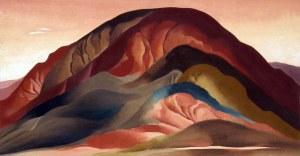
Credit: 2016 Georgia O’Keeffe Museum/DACS, London
Elaine de Kooning, like her husband, Willem, made their mark with abstract expressionism. To some thinkers, abstract expressionism is an evolution landscape painting devoid of a specific subject.
Elaine’s portrait of her husband (below), sits in the National Portrait Gallery. It neatly summarizes the tornado of the painter’s talent. It blends figure and ground into a single frenetic reverberation. We see the man as the energy that creates the room.
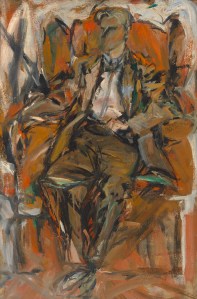
Credit: Willem de Kooning by Elaine de Kooning, 1952 NPG/SI, © Elaine de Kooning Trust
Each painter shares her unique observations. Each tempted to apply their talents in an unusual ways. This what makes them a painter’s painter.
 The Visual8